Setting your confidence
This is Step 3 of 3 — Confidence & settings — the final step before your hypothesis is saved. The same screen also collects two settings: visibility and review date (covered on the next page).

Why confidence is collected here
Confidence is asked after the causal chain and pre-mortem on purpose: working through "what could go wrong" should change your gut feel. If you set confidence first, you'll anchor on it and reason backwards. The system never lets you change that order.
Pick a level from 1 to 5
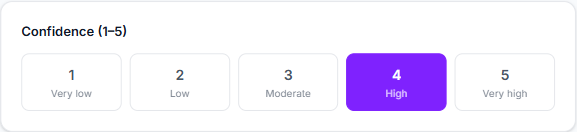
Click one of the five cards. The scale is deliberately coarse — there's no slider, no percentage box. The point is calibration over time, not false precision in a single bet.
| Score | Label | Rough meaning |
|---|---|---|
| 1 | Very low | Long-shot — I'd be surprised if this works |
| 2 | Low | Probably won't, but worth a try |
| 3 | Moderate | Genuinely uncertain — could go either way |
| 4 | High | I expect this to work |
| 5 | Very high | I'd bet a lot on this |
Tip: if every hypothesis you write is a 4 or 5, you're not stretching. A healthy bench has bets across the range.
What confidence is used for
- It anchors your calibration curve on the My Calibration page — the system compares each confidence level against actual hit rate.
- It is never overridable later. After saving, your confidence is locked. This is intentional: hindsight calibration would defeat the purpose.
Previous: Writing the pre-mortem ← Next: Visibility and review date →